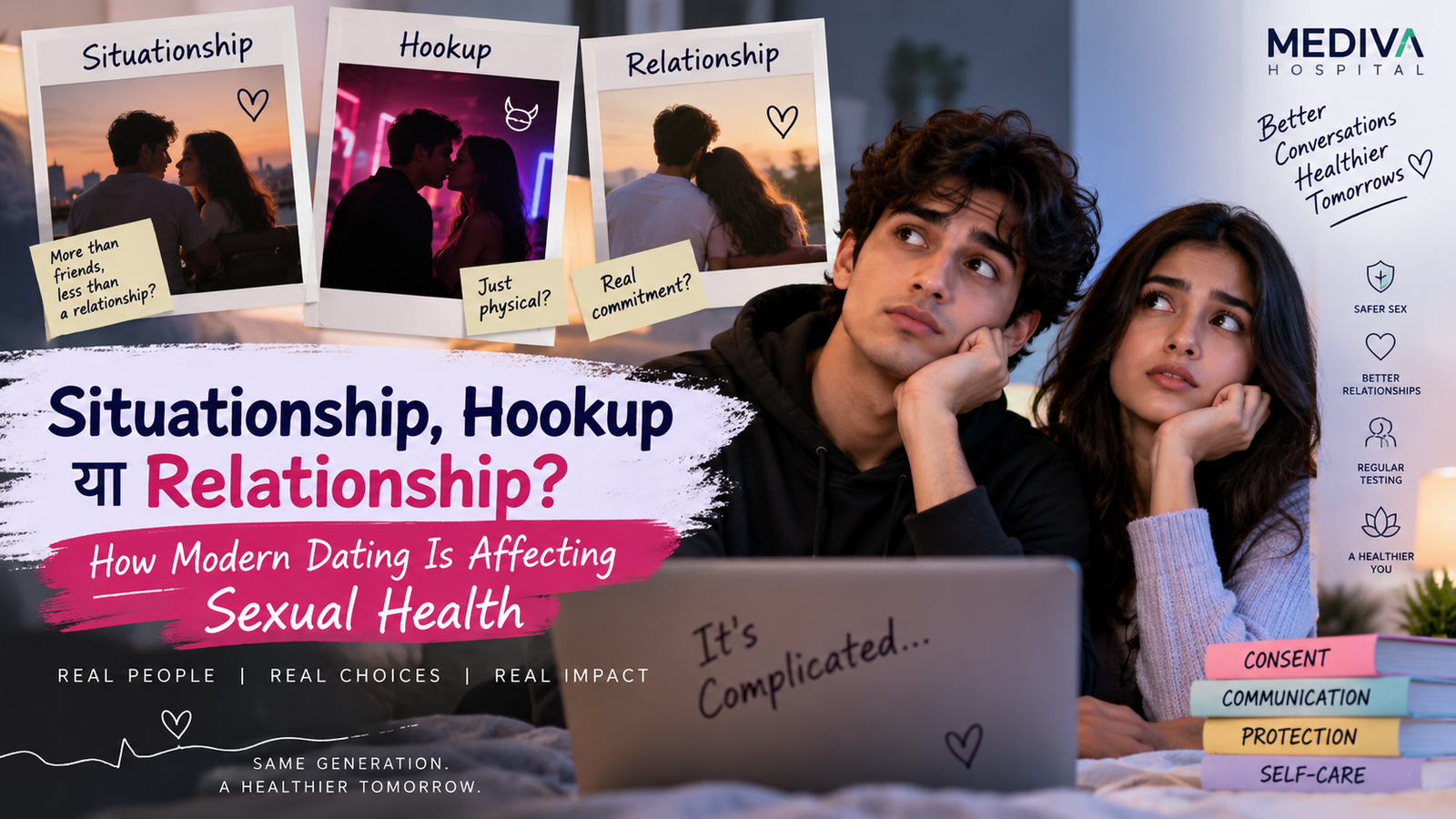
“So… What Are We?”
It starts with a DM.
Then late-night conversations.
Then “Netflix and chill.”
Then suddenly, you’re spending weekends together, sharing personal things, being physically intimate—but nobody has actually asked the question:
“Are we in a relationship?”
Welcome to the world of modern dating.
For Gen Z, dating isn’t always as simple as “single” or “in a relationship.” There are talking stages, hookups, casual dating, friends with benefits, situationships and everything in between.
And while changing dating culture isn’t necessarily a bad thing, it can create some very real questions about sexual health, emotional wellbeing, consent, contraception and sexually transmitted infections (STIs).
The important thing is this:
Your relationship status doesn’t determine your sexual health risk. Your sexual behaviour, communication, protection and testing habits matter much more.
Whether you’re in a serious relationship, enjoying casual dating or figuring out what your situationship even means, taking care of your sexual health should never be “too awkward” to discuss.
What Exactly Is a Situationship?
A situationship is generally a relationship that has romantic or sexual elements but doesn’t have clearly defined expectations or commitment.
You might:
- Talk every day
- Go on dates
- Sleep together
- Share emotional moments
- Get jealous when they talk to someone else
- Act like a couple
- But still say, “We’re not officially together.”
Sound familiar?
The problem isn’t the label.
A situationship can work perfectly well for two people if both understand and agree on what they want.
The difficulty starts when expectations are different.
One person may think:
“We’re keeping it casual.”
While the other thinks:
“We’re basically dating.”
That mismatch can affect emotional wellbeing and can also make conversations about sexual health more complicated.
Hookup vs Relationship: Does Sexual Health Risk Change?
Not necessarily.
A common misconception is:
“If I’m hooking up, I need to worry about sexual health—but if I’m in a relationship, I’m automatically safe.”
That’s not how sexual health works.
STIs can be transmitted through vaginal, anal and oral sex, as well as certain types of genital skin-to-skin contact. Many STIs can also occur without obvious symptoms.
That means someone can look completely healthy and still have an STI.
Your risk can depend on factors such as:
- Whether you use condoms or other barrier protection
- Whether you have one or multiple partners
- Whether you and your partner have been tested
- Whether partners have overlapping sexual relationships
- The type of sexual contact
- Whether you have symptoms
- Your vaccination status for preventable infections such as HPV and hepatitis B
So whether it’s a first date, a hookup, a situationship or a long-term relationship, sexual health conversations still matter.
7 Ways Modern Dating Can Affect Your Sexual Health
1. More Dating Partners Can Mean More STI Exposure
Modern dating apps and social media have made meeting new people easier than ever.
That’s not automatically unhealthy.
But having new or multiple sexual partners can increase opportunities for exposure to STIs, particularly when condoms aren’t used consistently or partners aren’t aware of each other’s testing status.
According to the World Health Organization, more than 1 million curable STIs are acquired every day worldwide among people aged 15–49, and many infections have no symptoms.
That’s why “They look healthy” isn’t a reliable way to judge STI status.
Testing is.
2. The “We’re Exclusive… Right?” Problem
This is where situationships can become confusing.
Imagine you’ve been seeing someone for three months.
You’re not officially dating.
You assume they’re only seeing you.
They assume you’re both free to date other people.
Neither person asks.
That isn’t just a relationship communication problem—it can become a sexual-health issue.
Before becoming sexually intimate, it’s reasonable to talk about:
“Are we seeing other people?”
“When were you last tested?”
“Do we want to use condoms?”
“What are we comfortable with?”
These conversations might feel awkward for 30 seconds.
Not having them can create much bigger problems later.
3. Condom Use Can Become Inconsistent
One of the biggest changes between casual dating and a committed relationship is often the way people approach condoms.
Someone may use condoms with a new partner but stop using them after they become emotionally comfortable.
That isn’t automatically unsafe—but it should be an informed decision.
If both partners want to stop using condoms, they should ideally discuss exclusivity, STI testing and contraception where pregnancy is possible.
When used correctly and consistently, condoms significantly reduce the risk of many STIs and can also help prevent unintended pregnancy.
But remember:
Condoms reduce risk; they don’t make risk zero.
4. “No Symptoms = No STI” Is a Dangerous Myth
This deserves its own section.
Many people delay testing because:
“I don’t have any symptoms, so I’m fine.”
Unfortunately, that’s not always true.
STIs can be asymptomatic, meaning a person may have an infection without noticing anything unusual.
Depending on the infection and the type of sexual exposure, symptoms may include:
- Unusual genital discharge
- Burning while urinating
- Genital sores
- Blisters
- Genital itching
- Pelvic pain
- Pain during sex
- Testicular pain
- Unusual bleeding
But having no symptoms does not automatically rule out an STI.
If you’ve had a potential exposure or are concerned about your sexual health, talk to a healthcare professional about appropriate testing.
5. Dating Anxiety Can Affect Sexual Performance
Modern dating isn’t only about physical health.
It can also affect your mental and sexual wellbeing.
You might be thinking:
“Will they like my body?”
“Am I good enough?”
“What if I can’t get hard?”
“What if I finish too quickly?”
“What if they compare me to someone else?”
That pressure can contribute to performance anxiety.
And here’s the frustrating part:
You worry about your performance → anxiety increases → sexual arousal becomes harder → something doesn’t go as planned → you worry even more next time.
It can become a cycle.
One difficult sexual experience doesn’t automatically mean you have a sexual disorder.
But if erection problems, premature ejaculation, low sexual desire or anxiety are happening repeatedly and affecting your confidence or relationships, speaking with a qualified healthcare professional can help.
6. Social Media Can Create Unrealistic Sexual Expectations
Instagram doesn’t show the whole relationship.
TikTok doesn’t show the whole bedroom.
Porn isn’t a sexual-health textbook.
Yet many young adults compare their bodies, relationships and sexual performance with what they see online.
That comparison can create unrealistic expectations around:
- Body appearance
- Penis size
- Sexual stamina
- Frequency of sex
- Orgasms
- “Perfect” relationships
- Sexual performance
Real intimacy isn’t a performance for an audience.
It’s about communication, comfort, consent, pleasure, respect and mutual trust.
7. Ghosting Doesn’t Just Hurt Feelings
Imagine this:
You had sex with someone.
A few days later, they disappear.
No message.
No explanation.
No way to ask about their sexual-health status.
This is one reason communication matters before and after sexual activity.
If you’re sexually active, knowing your own testing status and discussing sexual health with partners can help reduce uncertainty.
The CDC notes that STI testing decisions depend on factors such as sexual history, age, current sexual practices and symptoms, and recommends discussing appropriate testing with a healthcare professional.
How to Protect Your Sexual Health in the Modern Dating Era
You don’t need to stop dating.
You don’t need to avoid relationships.
And you definitely don’t need to feel ashamed about being sexually active.
You simply need better sexual-health habits.
1. Have the Conversation Before Sex
Don’t wait until after sex to discuss protection.
Ask:
“When were you last tested?”
“Are you seeing anyone else?”
“What protection do you prefer?”
“Are there any boundaries I should know about?”
Healthy communication isn’t a mood killer.
It’s part of good sexual health.
2. Use Condoms Correctly and Consistently
If you’re sexually active, condoms are an important tool for reducing the risk of many STIs and unintended pregnancy.
WHO recommends correct and consistent condom use during vaginal, oral and anal sex for STI and HIV prevention.
3. Consider STI Testing
Testing isn’t an accusation.
It isn’t about trust.
It is simply healthcare.
And because many STIs may not cause symptoms, testing can be important even when you feel completely fine.
Your healthcare provider can help determine which tests are appropriate based on your sexual history and exposure.
4. Don’t Ignore Sexual Symptoms
Don’t Google a symptom at 2 AM and convince yourself you’ve discovered the worst possible diagnosis.
At the same time, don’t ignore persistent symptoms.
If you notice unusual discharge, genital sores, burning, pain, sexual difficulties or other concerning changes, speak with a healthcare professional.
Early evaluation can provide clarity and, where appropriate, treatment.
Situationship or Relationship: What’s Actually Healthy?
Here’s the plot twist:
The label isn’t the most important thing.
A relationship can be healthy.
A situationship can be healthy.
Casual dating can be healthy.
What matters is whether there is:
✅ Mutual consent
Both people genuinely want what’s happening.
✅ Clear communication
You know what you’re comfortable with—and can say it.
✅ Respect
Boundaries aren’t mocked, pressured or ignored.
✅ Sexual-health awareness
You discuss protection, testing and relevant sexual-health concerns.
✅ Honesty
Nobody is being deliberately misled about exclusivity or expectations.
✅ Emotional responsibility
You understand that casual sex doesn’t mean someone has no feelings—and having feelings doesn’t automatically create a commitment.
The Gen-Z Sexual Health Checklist
Before getting intimate with a new partner, ask yourself:
☐ Do I genuinely want this?
☐ Have we discussed consent and boundaries?
☐ Do I know whether we’re exclusive or not?
☐ Have we discussed protection?
☐ Do I know when I was last tested?
☐ Do I understand my partner’s sexual-health expectations?
☐ Am I comfortable saying “no” at any point?
☐ Am I making this decision because I want to—or because I feel pressured?
If you can’t answer some of these questions, that’s okay.
It simply means it’s time for a conversation.
When Should You See a Sexologist?
You don’t have to wait until a problem becomes severe.
Consider speaking with a qualified sexologist or healthcare professional if you’re experiencing persistent:
- Erectile difficulties
- Premature ejaculation
- Low sexual desire
- Pain during sex
- Difficulty with arousal
- Performance anxiety
- Sexual confidence issues
- Concerns about masturbation or pornography
- Genital symptoms
- Possible STI exposure
- Relationship-related sexual difficulties
Sexual health is healthcare.
There is no prize for suffering silently.
Final Thoughts: Your Dating Life Is Yours—Your Sexual Health Should Be Too
The dating world has changed.
“Boyfriend” and “girlfriend” aren’t the only relationship categories anymore.
There are talking stages, casual dating, hookups, friends with benefits, situationships, open relationships and everything in between.
But one thing hasn’t changed:
You are responsible for taking care of your sexual health.
Don’t let a dating label decide whether you communicate.
Don’t let embarrassment stop you from getting tested.
Don’t let social media define what “normal” sex should look like.
And don’t confuse emotional closeness with sexual-health safety.
Whether you’re saying “It’s complicated” or “We’re official,” healthy intimacy starts with the same things:
Consent. Communication. Protection. Testing. Respect.
And honestly?
That’s a much better relationship status than “It’s complicated.”
Frequently Asked Questions
1. Can a situationship affect sexual health?
A situationship itself doesn’t cause sexual-health problems. However, unclear expectations about exclusivity, multiple partners, condom use or STI testing can increase uncertainty and may increase exposure to STIs.
2. Is casual sex unhealthy?
Casual sex is not automatically unhealthy. Sexual health depends on factors such as consent, communication, protection, testing and individual circumstances.
3. Can you have an STI without symptoms?
Yes. Many STIs can cause no noticeable symptoms, which is why testing can be important after certain sexual exposures.
4. Should you get an STI test after a hookup?
It may be appropriate depending on the type of sexual contact, protection used, partner history, symptoms and other risk factors. A healthcare professional can advise you about the right tests and timing.
5. Do condoms completely prevent STIs?
No. Correct and consistent condom use significantly reduces the risk of many STIs, but it does not eliminate all risk, particularly for infections that can spread through skin-to-skin contact outside the area covered by a condom.
6. Can dating anxiety cause erectile problems?
Yes. Anxiety and pressure around sexual performance can interfere with arousal and erections. If the problem happens repeatedly, consulting a healthcare professional can help identify the underlying cause.
7. When should I see a sexologist?
If sexual problems are persistent, distressing or affecting your confidence, relationship or quality of life, professional evaluation can help. You should also seek medical advice for concerning genital symptoms or possible STI exposure.
Takeaway
Modern dating isn’t the problem. Lack of communication can be.
Whether you’re in a situationship, hookup, talking stage or committed relationship, make sexual health part of the conversation.
Because being sexually confident isn’t just about performance.
It’s about being informed, protected, respectful and comfortable with your choices.
Mediva Hospital provides confidential, professional sexual-health consultations for people dealing with sexual and relationship-related concerns. If something about your sexual health is worrying you, speaking with a qualified professional is a better option than silently stressing or relying on random internet advice.
This article is for educational purposes and does not replace an individual medical consultation.
